A complete guide to better sleep naturally
You can support better sleep naturally by keeping a consistent bedtime, limiting screens before bed, and winding down with calming routines. Ayurvedic practices like warm oil massage and herbal support may also help. A free doctor consultation can guide you toward what suits your situation best.
Sleep is not a luxury - it is how your body heals itself
Nearly 87 percent of Indian adults report poor sleep at least a few nights a week. In cities like Mumbai, Delhi, and Bengaluru, restless nights have quietly become routine. But broken sleep is not something you simply have to accept.
This guide walks you through what actually happens inside your body during sleep, how much rest Indian adults genuinely need, and the most common reasons sleep slips away. You will also find practical, natural steps you can take tonight. Where Ayurvedic support fits in, we explain it plainly and honestly.
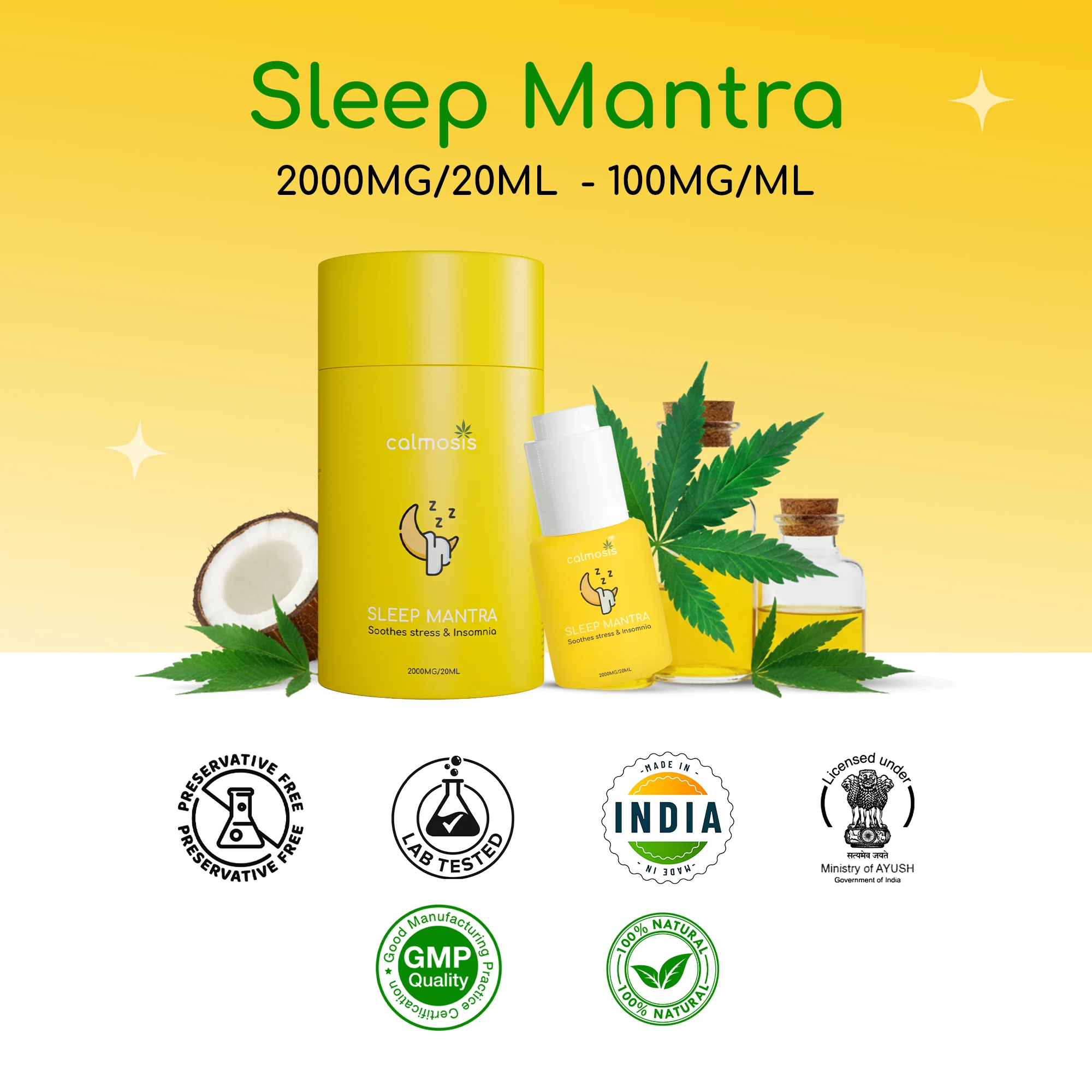
Sleep Mantra, a formulation drawing on Vijaya (cannabis) and traditional Ayurvedic herbs, may support more restful nights as part of a broader sleep routine. Read through, try what fits your life, and if you have specific concerns, a qualified Calmosis physician is available for a free consultation.
Why sleep is the foundation of everyday health
Across India, millions of adults lie awake at night staring at the ceiling. A 2023 LocalCircles survey found that nearly 87 percent of Indian respondents reported poor sleep quality at least a few nights a week.
In cities like Mumbai, Delhi, and Bengaluru, late work hours, long commutes, and constant digital noise have quietly made restless nights feel normal. They are not normal, and they are not harmless.
Sleep is not passive downtime. It is the period when your body repairs tissue, your brain files away memories, and your immune system recalibrates.
Cutting it short or fragmenting it night after night chips away at your mood, your focus, your metabolism, and your long-term wellbeing in ways that a strong cup of chai cannot undo.
This guide covers what sleep actually does, how much you need, why it slips away, and what you can do tonight to start sleeping better.
It draws on both current research and Ayurvedic tradition, including the classical use of Vijaya (cannabis, the plant known in Ayurveda as a calming herb) for rest and ease. Every practical step here is grounded in either evidence or centuries of traditional use.
Nothing here is a miracle fix, and if your sleep troubles are persistent or tied to a specific health concern, a qualified doctor is the right next step.
What actually happens when you sleep
Sleep is not one long, uniform state. Every night your brain cycles through two main types of sleep, and those cycles repeat roughly four to six times before morning.
The first type is non-REM sleep (NREM, meaning sleep without rapid eye movement). NREM itself has three stages. Stage 1 is the light drift between wakefulness and sleep, lasting only a few minutes. Stage 2 is a deeper, steadier rest where your heart rate slows and your body temperature drops.
Stage 3, sometimes called slow-wave or deep sleep, is the most physically restorative stage. During Stage 3 your body releases growth hormone, repairs muscle and tissue, and strengthens the immune response.
Adults spend roughly 20 to 25 percent of their total sleep time in this stage, mostly in the first half of the night.
The second type is REM sleep (rapid eye movement sleep), which arrives roughly 90 minutes after you first fall asleep. REM is when most vivid dreaming happens. Your brain is nearly as active as when you are awake. This stage is critical for consolidating memory, processing emotions, and restoring mental sharpness.
Adults spend about 20 to 25 percent of sleep in REM, with the longest REM periods arriving in the final hours of the night.
This timing explains why interrupted sleep feels so destructive even when the total hours look acceptable. If you wake at 3 am and cannot return to sleep, you lose most of your REM. If you sleep only five hours, you cut short the deep Stage 3 repair work.
Your body keeps score of both. The grogginess, the irritability, the difficulty concentrating the next day, all of that is your brain and body telling you that a critical process was cut short.
How much sleep Indian adults actually need
The National Sleep Foundation recommends that adults between 18 and 64 years of age get 7 to 9 hours of sleep per night. Adults over 65 generally do well with 7 to 8 hours. Teenagers between 14 and 17 need 8 to 10 hours, and school-age children need more still.
These ranges apply to Indian adults as much as to anyone else. Genetics can shift individual needs slightly, but the idea that some people genuinely thrive on five hours is largely a myth.
Most people who claim to function well on five hours have simply adapted to a state of chronic tiredness and forgotten what fully rested feels like.
Urban India creates specific pressures that push sleep time down. In Mumbai, traffic data suggests the average commute adds significant time to each end of the working day, and many professionals in IT hubs like Bengaluru and Hyderabad work across time zones, keeping late calls with international teams.
Delhi's ambient noise levels, reported above 65 decibels in many residential areas at night, make it harder to fall into the deep sleep stages the body needs.
Hours alone, however, do not tell the full story. Seven hours of fragmented, light sleep leaves you worse off than six hours of unbroken, deep sleep. Quality and continuity matter as much as duration.
A consistent sleep schedule, where you go to bed and wake at roughly the same time every day, including weekends, is one of the strongest predictors of sleep quality that researchers have found.
Common reasons sleep slips away
Most poor sleep in Indian adults traces back to a handful of very common, very fixable causes.
- Stress and an overactive mind. When the day's worries follow you to bed, your brain stays in a low-level alert state. Cortisol, the stress hormone, suppresses melatonin and keeps you from dropping into deep sleep.
- Screen light in the evening. The blue-wavelength light from phones, laptops, and televisions signals your brain that it is still daytime. It suppresses melatonin production for up to two hours after you stop looking at a screen.
- Irregular schedules. Shifting your sleep and wake times by even 90 minutes on weekends creates what researchers call social jet lag. Your internal clock drifts, and Monday mornings feel like arriving from a different time zone.
- Late and heavy meals. India's dinner culture often means eating at 9 pm or later. A full stomach raises your core body temperature and keeps your digestive system active, both of which interfere with the body-cooling process that triggers deep sleep.
- Caffeine after 2 pm. Caffeine has a half-life of roughly five to six hours in most adults. A cup of chai at 4 pm still has half its caffeine circulating at 9 pm. For people who metabolize caffeine slowly, the effect lasts even longer.
- Noise and heat. Urban ambient noise and the heat of Indian summers, particularly in cities like Chennai and Ahmedabad where nights regularly stay above 28 degrees Celsius, make it physically harder for the body to reach the cooler core temperature it needs for deep sleep.
None of these causes requires a prescription to address. Most respond well to consistent habit changes, which the later sections of this guide cover in detail.
Sleep in Ayurveda: what the tradition says
Ayurveda, India's classical system of natural medicine with roots stretching back more than 3,000 years, places sleep among the three essential pillars of health. The classical texts call these pillars ahara (food), brahmacharya (regulated energy), and nidra (sleep).
Of the three, nidra receives some of the most detailed attention in foundational texts like the Charaka Samhita and Ashtanga Hridayam.
Charaka writes that nidra bestows happiness, nourishment, strength, virility, knowledge, and life itself when taken properly. Conversely, improper or insufficient nidra is a root cause of misery, wasting, and weakness.
This framing, written roughly 2,000 years ago, aligns closely with what modern sleep research now confirms about the systemic consequences of poor rest.
In Ayurvedic theory, three doshas (functional energies) govern the body and mind: Vata, Pitta, and Kapha. Vata, associated with movement, air, and the nervous system, is the dosha most closely linked to sleep disturbance.
When Vata rises out of balance, the mind becomes restless, thoughts race, and the body finds it hard to settle.
Ayurvedic practitioners have long observed that Vata tends to increase in the evening hours, which is why calming Vata through warm foods, oil massage, and grounding herbs before bed has been a central part of Ayurvedic sleep care for centuries.
Kapha, by contrast, is the dosha associated with heaviness, stability, and ease. Practices that gently increase Kapha in the evening, such as warm sesame oil massage (abhyanga) and warm milk preparations, are traditional tools for easing the transition into restful sleep.
This tradition does not frame sleep as a problem to be fixed with a single remedy. It frames it as a daily practice, a rhythm to be cultivated with consistent habits, the right foods, and the right timing.
Vijaya and rest: the Ayurvedic perspective
Vijaya is the classical Ayurvedic name for the cannabis plant. It appears in several foundational Ayurvedic texts, including the Charaka Samhita and Sushruta Samhita, where practitioners describe it as a plant with properties that may support calm, ease, and rest.
In traditional Ayurvedic formulation, Vijaya carries anodyne (pain-relieving) and sedative qualities, and practitioners have traditionally used it to support a quieter mind and more restful sleep.
Vijaya-based formulations from an AYUSH-certified brand like Calmosis are positioned as traditional wellness support, not as treatments for any medical condition. They are not a substitute for medical care.
If you have a diagnosed sleep disorder or a condition that affects your sleep, the right first step is always a conversation with a qualified physician.
In the Ayurvedic framework, Vijaya may work by calming excess Vata, the restless, airy energy that keeps the mind spinning at bedtime. Traditionally, small, carefully prepared doses have supported the transition into rest and eased the mental activity that disrupts sleep onset.
Calmosis formulations follow classical preparation principles and are developed under AYUSH guidelines.
As with all Ayurvedic herbs, the appropriate preparation, dose, and combination depend on an individual's constitution (prakriti) and current state of balance. This is why Calmosis pairs every product with access to a free consultation with a qualified Ayurvedic physician.
If you are curious about whether a Vijaya-based formulation might support your rest, the clearest path forward is to book a free consultation and speak with a doctor who can assess your specific situation.
Natural habits that may support better sleep
The habits below draw on both sleep research and Ayurvedic tradition. None of them requires a product. All of them are worth trying before anything else.
- Keep a consistent sleep schedule. Go to bed and wake at the same time every day, including Sundays. Your circadian rhythm (your body's internal 24-hour clock) strengthens with repetition and weakens with variation. Even a 30-minute shift on weekends should be avoided, as it can disrupt the following week.
- Make your room cool and dark. Your core body temperature needs to drop by roughly 1 to 2 degrees Celsius to initiate deep sleep. Aim for a room temperature between 18 and 22 degrees Celsius if your climate allows. Block out light with curtains or a sleep mask.
- Stop screens 30 minutes before bed. This is the minimum. Sixty minutes is better. If you must use a phone, switch to night mode and reduce brightness significantly.
- Avoid caffeine after 2 pm. This includes chai, coffee, cola, and dark chocolate. If you are sensitive to caffeine, move the cutoff earlier.
- Eat your last meal at least two hours before bed. A lighter evening meal is easier on digestion and keeps your core temperature from rising at the wrong time. Ayurveda specifically recommends warm, cooked, easily digestible food in the evening.
- Try abhyanga before bed. Warm sesame oil massaged into the feet, scalp, and limbs for 10 to 15 minutes is a traditional Ayurvedic practice for calming Vata and signaling the body that it is time to rest. Research on self-massage suggests it may reduce cortisol and promote relaxation.
- Warm milk with ashwagandha. A small cup of warm milk with half a teaspoon of ashwagandha powder is a traditional preparation that Ayurvedic practitioners have used for centuries to support calm before sleep. Ashwagandha (Withania somnifera) has been studied for its adaptogenic properties, and preliminary research suggests it may support sleep quality in adults under stress.
- Add gentle movement in the evening. A 15-minute walk after dinner or a short yoga sequence supports digestion and lowers the physical tension that accumulates through the day. You should avoid vigorous exercise within two hours of bedtime, as it raises core temperature and heart rate.
- Write down tomorrow's tasks. Racing thoughts about unfinished work are a common trigger for sleep-onset difficulty. Spending five minutes writing a to-do list before bed has been shown in research to help the brain release its grip on those items and settle more easily.
How natural sleep supports compare at a glance
The table below outlines common natural approaches to sleep support, what each one targets, its basis in tradition or research, and any practical considerations. No approach listed here treats or cures any medical condition.
| Approach | What it targets | Basis | Considerations |
|---|---|---|---|
| Consistent sleep schedule | Circadian rhythm stability, sleep onset, and morning alertness | Well-supported by sleep research; foundational in Ayurvedic dinacharya (daily routine) | Requires commitment on weekends; benefits build over two to four weeks |
| Screen and light reduction | Melatonin suppression from blue light in the evening | Research-supported; aligns with Ayurvedic guidance to reduce stimulation after sunset | 30 to 60 minutes before bed is the minimum effective window |
| Abhyanga (self oil massage) | Nervous system calming, Vata pacification | Classical Ayurvedic practice; preliminary research suggests relaxation and cortisol reduction | Use warm sesame oil; avoid if you have a skin condition without physician guidance |
| Ashwagandha | Stress response, sleep quality in adults under stress | Ayurvedic adaptogen with growing clinical interest; a 2019 study in PLOS ONE found it may support sleep quality | Consult a physician for dose and duration; not suitable for everyone |
| Vijaya (cannabis) oil, Ayurvedic formulation | Traditionally used to support calm, ease mental restlessness, and aid the transition to rest | Classical Ayurvedic texts; AYUSH-certified formulation from Calmosis | Dose and suitability depend on individual constitution; a free doctor consultation is strongly recommended before use |
| Dietary adjustments (light evening meals, caffeine cutoff) | Core body temperature regulation, digestive interference with sleep | Research-supported; central to Ayurvedic ahara (dietary) guidelines | Effects are gradual; most noticeable after one to two weeks of consistency |
| Gentle evening movement or yoga | Physical tension release, cortisol reduction | Research-supported; Ayurvedic tradition recommends light movement after the evening meal | Avoid vigorous exercise within two hours of bedtime |
| Warm milk with ashwagandha or nutmeg | Vata calming, warmth-induced relaxation | Traditional Ayurvedic preparation used for centuries across India | Use dairy or a plant-based alternative; keep the preparation warm, not hot |
Frequently asked questions about The Ultimate Guide to Better Sleep Naturally
How much sleep do Indian adults actually need?
Most Indian adults need seven to nine hours of sleep each night. Individual needs vary by age, activity level, and health. If you consistently wake unrefreshed despite adequate hours, speaking with a qualified physician through our free consultation is a sensible next step.
What is Vijaya and how does it relate to sleep in Ayurveda?
Vijaya is the classical Ayurvedic name for cannabis. In Ayurvedic tradition, Vijaya has been used to support calm and rest. Calmosis formulations draw on this tradition. For guidance on whether a Vijaya-based product suits your needs, book a free doctor consultation.
Why do I keep waking up at night?
Frequent night waking often links to stress, irregular schedules, excess screen time, or an imbalanced Vata dosha according to Ayurveda. Identifying the root cause matters. If waking disrupts your daily life regularly, a qualified physician through our free consultation can help you understand what is happening.
What actually happens to your body while you sleep?
During sleep your body repairs tissue, consolidates memories, and regulates hormones. The brain clears metabolic waste through the glymphatic system. Each sleep cycle lasts roughly 90 minutes and moves through light, deep, and REM stages, each serving a distinct recovery function.
What does Ayurveda say about sleep?
Ayurveda calls sleep one of the three pillars of health, alongside diet and a balanced lifestyle. The tradition links poor sleep to Vata and Pitta imbalances. Classical texts recommend consistent sleep and wake times, a light evening meal, and calming pre-bed rituals to support rest.
Are natural sleep supports safe to use every night?
Many natural habits, such as reducing caffeine and keeping a steady schedule, are generally well-tolerated daily. Herbal or Vijaya-based formulations may support rest, but suitability varies by person. A physician through our free doctor consultation can advise on regular use for your specific situation.
Can stress cause poor sleep?
Yes, stress is one of the most common reasons sleep slips away. Elevated cortisol keeps the nervous system alert when it should be winding down. Calming practices and traditionally used Ayurvedic support may help ease that transition. For persistent stress-related sleep concerns, consult a doctor.
What natural habits may support better sleep tonight?
Dimming lights an hour before bed, avoiding heavy meals after 8 pm, and keeping your room cool and dark are practical starting points. A short breathing exercise or warm herbal drink may also support a calmer transition to sleep, according to Ayurvedic tradition.
How does Calmosis Vijaya oil support rest?
Calmosis Vijaya oils are traditionally used Ayurvedic formulations that may support calm and restful sleep. They are AYUSH-certified and positioned as everyday wellness support, not as a treatment for any condition. To find the right product for your needs, book a free doctor consultation.
Start tonight: steps toward genuinely restful sleep
You do not need to overhaul your entire routine to start sleeping better. A few well-chosen changes, applied consistently, tend to produce noticeable results within one to two weeks.
Tonight, pick a bedtime and commit to it. Set a wake alarm for the same time tomorrow, regardless of when you fall asleep. Put your phone face-down and out of arm's reach 30 minutes before that bedtime. Eat your dinner before 8 pm if your schedule allows.
If your mind is busy, spend five minutes writing down what needs doing tomorrow, then set the list aside.
This week, try abhyanga two or three evenings. Warm a small amount of sesame oil, massage it into your feet and scalp for 10 minutes, and follow it with a warm shower. Notice whether your body settles more easily afterward.
Swap your post-2 pm chai for warm water or a caffeine-free herbal drink.
Over the next month, let the schedule anchor everything else. Consistency is the variable that sleep researchers return to most often. Your circadian rhythm is trainable, but it responds to repetition, not to occasional effort.
If you are curious about Ayurvedic support, including whether a Vijaya-based formulation from Calmosis may be appropriate for your situation, the right next step is a conversation with a qualified physician rather than a guess. Ayurvedic herbs work best when matched to your individual constitution and current state of balance.
If your sleep difficulties are persistent, if you wake unrefreshed most mornings, if daytime fatigue is affecting your work or relationships, or if you have any underlying health concern that may be connected to your sleep, please do not face that alone.
A Calmosis physician can review your situation, answer your questions honestly, and help you understand which approaches are worth trying in your specific case.
The consultation is free, it is with a real qualified doctor, and it is the clearest path to support that is actually suited to you. Book a free consultation and take the first step toward genuinely restful nights.
Shop Sleep Mantra