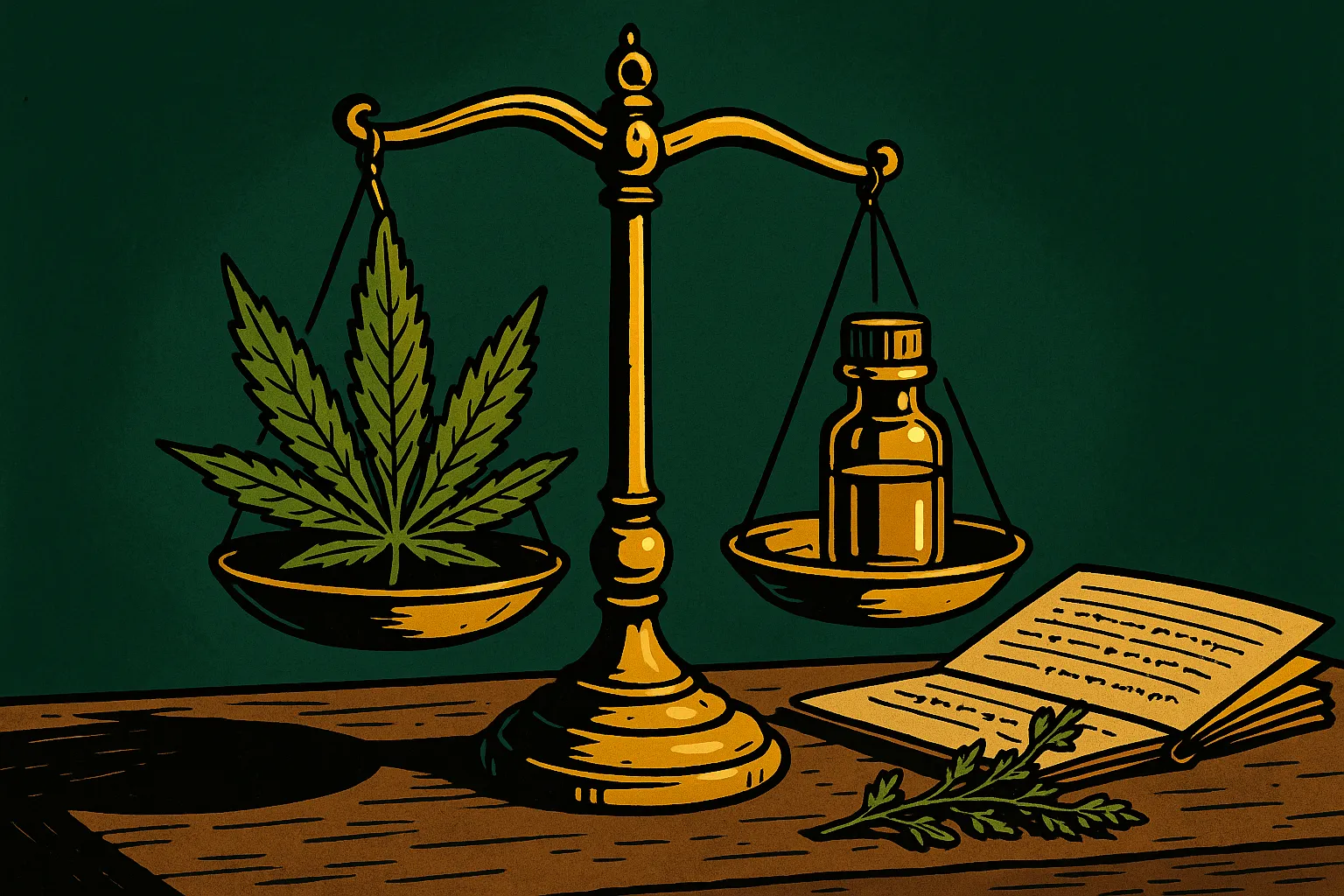
Is cannabis oil legal in India? Understanding AYUSH guidelines
Yes, cannabis oil is legal in India under specific conditions. It must carry AYUSH certification, come from a licensed manufacturer, contain THC within permitted limits, and be sold through a regulated channel. Buying outside these conditions puts you on the wrong side of the NDPS Act 1985.
What the law actually says about cannabis oil in India
If you have searched 'is cannabis oil legal in India' and come away more confused than when you started, you are not alone. The answer sits inside three overlapping frameworks: the NDPS Act of 1985, classical Ayurvedic tradition, and AYUSH licensing rules. Each layer matters.
India does not permit recreational cannabis, but it has a long, documented history of using Vijaya (cannabis) as an Ayurvedic ingredient, and that tradition has a clear legal home today.
This article walks through exactly what the law permits, where Vijaya fits in Ayurvedic texts, and the four conditions that make a cannabis oil purchase legal. By the end, you will know what to look for on a label and when to involve a qualified physician before you buy.
Is cannabis oil legal in India? The short answer
Yes, cannabis oil can be legally purchased in India, but only under specific conditions. The answer is not a flat yes or no. It is a yes-with-conditions that depends on what the oil contains, who made it, how it was licensed, and whether a qualified physician has guided your use.
India does not permit recreational cannabis products. However, the country has a long, documented tradition of using cannabis in Ayurvedic medicine, and that tradition now has a regulatory home under the Ministry of AYUSH.
Brands that manufacture cannabis-based wellness oils within that framework, using approved plant parts, staying within permitted THC (tetrahydrocannabinol, the compound responsible for psychoactive effects) limits, and holding valid AYUSH licenses, operate entirely within the law.
If you have heard about Vijaya oil or CBD oil and want to know whether you can buy it without legal risk, the answer is yes, provided you choose a licensed brand, understand what you are buying, and speak with a doctor first.
The rest of this article walks you through exactly how that works.
What the NDPS Act 1985 actually says about cannabis
The Narcotic Drugs and Psychotropic Substances Act, 1985, commonly called the NDPS Act, is India's central law governing controlled substances. Cannabis appears in it, but the Act does not treat the entire plant as illegal. The distinction it draws is precise and important for anyone thinking about buying cannabis oil.
The NDPS Act defines three cannabis-derived substances:
- Ganja - the flowering or fruiting tops of the cannabis plant, including any attached resin. This is a controlled substance under the Act.
- Charas - the separated resin extracted from the cannabis plant, including hashish. This is also a controlled substance.
- Cannabis plant leaves and seeds - these are explicitly excluded from the definition of ganja and charas. The Act does not schedule them as narcotic drugs in the same way.
This distinction matters because Ayurvedic formulations, including the oils sold by AYUSH-licensed brands, are typically derived from the leaves and seeds of the cannabis plant, not from the flowering tops or resin.
That places them outside the most restricted category in the NDPS Act, provided the THC content stays within the limits regulators set.
State governments also retain the power to regulate cannabis under the NDPS Act. The central law sets the floor, but individual states can add their own rules on top. A buyer in one state may face different practical requirements than a buyer in another.
The section on state-level rules below covers that in more detail.
The key takeaway is this: the NDPS Act does not make all cannabis products illegal. It makes specific, high-THC, psychoactive forms of cannabis illegal. Ayurvedic formulations made from permitted plant parts, within permitted THC thresholds, and licensed by AYUSH occupy a legally recognized space.
Where Vijaya fits in Ayurveda and AYUSH regulation
Vijaya is the classical Sanskrit name for cannabis. It appears in foundational Ayurvedic texts including the Sushruta Samhita and the Charaka Samhita, where classical physicians described it as a plant with properties traditionally used to support calm, digestion, and relief from everyday discomfort.
The name Vijaya is often translated as "victorious," which reflects the esteem in which those physicians held the plant.
This is not a modern rebranding exercise. Vijaya has been part of the documented Ayurvedic pharmacopoeia for centuries.
When India's Ministry of AYUSH, the government body that oversees Ayurveda, Yoga, Unani, Siddha, and Homeopathy, began creating a regulatory pathway for cannabis-based formulations, it recognized this classical tradition and built licensing rules around it.
Under AYUSH guidelines, a manufacturer who wants to produce Vijaya-based oils or formulations must apply for a license that covers the specific product, its ingredients, its THC content, and its intended use as a wellness or Ayurvedic product. The license is not automatic.
It requires documentation, quality testing, and compliance with Good Manufacturing Practices.
This regulatory framework does several things at once. It separates Ayurvedic Vijaya products from pharmaceutical cannabis products, which fall under a different regulatory body. It separates them from recreational products, which remain illegal.
And it gives consumers a reliable signal: if a brand holds a valid AYUSH license for its Vijaya formulation, it has passed through a government-supervised process.
Calmosis operates within this framework. Its products are AYUSH-certified Ayurvedic formulations, not pharmaceutical drugs and not recreational products. That distinction is the legal and ethical foundation of everything the brand sells.
The four conditions that make a cannabis oil purchase legal
Buying cannabis oil legally in India is straightforward once you know what to look for. Four conditions must be in place at the same time.
- Medicinal or wellness purpose - the product must be intended for a recognized Ayurvedic or wellness use, not for recreational consumption. AYUSH-licensed products are formulated and sold with this purpose stated on the label and in the product documentation.
- AYUSH-licensed brand - the manufacturer must hold a valid AYUSH license for the specific formulation. This license number should appear on the product packaging. A brand without this license is not operating in the legal Ayurvedic framework, regardless of what it claims on its website.
- THC within the permitted limit - the oil must contain THC at or below the threshold recognized for Ayurvedic use. Products derived from cannabis leaves and seeds, rather than flowering tops, naturally contain low THC. Any reputable brand will publish a third-party lab certificate confirming this figure.
- A valid prescription or doctor consultation - the specific prescription requirement varies by state and by the THC level of the product. Consulting a qualified physician before purchasing is both the safest legal practice and the most sensible health decision. A doctor should confirm whether a particular formulation is appropriate for you and provide documentation of that recommendation if required.
If all four of these conditions are met, you are buying a legal Ayurvedic product through a legal channel. If any one of them is missing, the purchase carries legal or health risk that is not worth taking.
How THC percentage affects legality: a quick comparison
Not all cannabis oils carry the same legal status in India. The THC percentage in a product is one of the most important factors that determines where it sits under the NDPS Act and AYUSH guidelines.
The table below compares three broad product categories so you can see the differences at a glance.
| Product type | Typical THC level | NDPS Act status | AYUSH licensing required | Prescription or doctor consultation | Legally available in India |
|---|---|---|---|---|---|
| Hemp-derived CBD oil (from seeds and stalks) | Typically below 0.3%; confirm with current AYUSH guidelines | Not scheduled as ganja or charas; falls outside the controlled definition when derived from permitted plant parts | Yes, if sold as an Ayurvedic formulation | Recommended; required in some states | Yes, under AYUSH framework |
| Low-THC Vijaya Ayurvedic oil (leaves and seeds) | Low THC; exact threshold set by AYUSH licensing terms | Permissible under AYUSH guidelines when derived from leaves and seeds, not flowering tops | Yes, mandatory | Required; physician guidance is integral to the AYUSH model | Yes, with valid AYUSH license and physician oversight |
| Higher-THC cannabis products (flowering tops or resin) | Above permitted thresholds, often significantly higher | Classified as ganja or charas; controlled under the NDPS Act | Not applicable under AYUSH; would require separate pharmaceutical or research authorization | Not available through standard retail or Ayurvedic channels | No, not for general sale or personal use |
The practical implication is clear. If a product does not state its THC percentage, does not publish a lab certificate, or does not carry an AYUSH license number, you have no reliable way to know which category it falls into. Always ask for the certificate of analysis before purchasing.
State-level rules: why the answer can vary by location
India's legal system gives both the central government and state governments authority over narcotic drugs. The NDPS Act operates at the central level and sets the national framework.
But individual states have their own excise departments, their own licensing bodies, and in some cases their own rules that go beyond what the central law requires.
This matters for cannabis oil buyers in a practical way. A product that a manufacturer makes and sells legally under AYUSH guidelines at the national level may still face additional requirements in certain states.
Some states require a prescription from a registered medical practitioner before a consumer can purchase even a low-THC Ayurvedic formulation. Others have stricter rules on how such products can be advertised, stored, or transported within state borders.
A few examples show the variation. Uttarakhand was among the first states to permit licensed hemp cultivation and has developed a relatively clear framework for hemp-derived products. Himachal Pradesh has a long history of cannabis cultivation but also strict enforcement of NDPS provisions.
States with more conservative excise policies may treat even AYUSH-licensed cannabis products with additional scrutiny.
The safest approach for any buyer is to check the rules in their specific state before purchasing. A qualified physician who regularly advises on Vijaya formulations will typically know the current requirements in your state and should guide you accordingly.
This is another reason why a doctor consultation is not just a wellness step but a legal safeguard.
Do not assume that because a product is legally sold in one Indian city it carries identical legal status in another. Confirm locally, consult a doctor, and keep your purchase documentation.
What to check before you buy any cannabis oil in India
A legitimate, legal cannabis oil product in India will be able to answer every item on this checklist. If a brand cannot or will not provide this information, that is a reason to look elsewhere.
- AYUSH license number - this should appear on the product label and on the brand's website. You can verify an AYUSH license through the Ministry of AYUSH's official portal. A missing or unverifiable license number is a serious red flag.
- Third-party certificate of analysis - an independent laboratory should have tested the product and confirmed its THC and CBD (cannabidiol, another compound found in cannabis) content. The lab should be accredited, and the certificate should be dated and product-specific. Do not accept a generic or undated certificate.
- Clear THC declaration on the label - the label must state the THC percentage. Any product that lists only "cannabis extract" or "hemp extract" without specifying THC content does not give you the information you need to make a legal and safe purchase.
- Named ingredients and Ayurvedic context - a genuine Ayurvedic formulation will list its ingredients in line with classical Ayurvedic nomenclature and will explain the traditional use of each ingredient. Vague ingredient lists are a warning sign.
- A consulting physician on the platform - the brand should offer access to a qualified doctor who can review your health situation and recommend the right formulation. This is not a marketing add-on. It is a structural part of the AYUSH model and a legal protection for both the brand and the buyer.
- Clear return and complaint policy - a brand that operates transparently will have a visible grievance mechanism and a return policy. This signals accountability.
Calmosis meets each of these criteria. Its products carry AYUSH certification, publish third-party lab results, state THC content clearly, and include a free consultation with a qualified physician as a core part of the purchase experience.
Why a doctor consultation sits at the center of the legal process
One pattern that appears consistently across India's AYUSH framework is the central role of the physician. This is not incidental. Ayurveda has always placed the qualified practitioner, the vaidya (an Ayurvedic physician), at the start of any wellness decision, not at the end of it.
A doctor consultation does practical work that a product label cannot do. The physician reviews your personal health history. They check whether any medicines you already take could interact with a Vijaya formulation. They assess your constitution and circumstances, and they recommend a specific product and dosage rather than a general one.
In states where a written recommendation is required before purchase, the consultation also produces the documentation you need to buy legally.
Approaching a Vijaya oil purchase without physician input means making a decision with incomplete information. The consultation removes that gap. It also means that if your situation changes, you have a named, qualified professional who already knows your case and should advise you further.
Calmosis offers this consultation free of charge. The physician is real, qualified, and familiar with Vijaya formulations. The conversation is the starting point, not an optional extra.
If you want to understand whether a Vijaya oil may support your sleep, your stress levels, or your everyday comfort, book a free consultation and begin there.
Frequently asked questions about Is Cannabis Oil Legal in India? Understanding AYUSH Guidelines
What does the NDPS Act 1985 say about cannabis oil?
The NDPS Act 1985 prohibits cannabis resin and flowers but permits the leaves, seeds, and roots of the plant. Ayurvedic formulations made from permitted plant parts and approved by AYUSH fall outside the Act's ban, making them legally available to adult consumers in India.
What is Vijaya and how does it relate to cannabis oil?
Vijaya is the classical Ayurvedic name for cannabis. Ayurvedic texts have traditionally used Vijaya to support calm, rest, and everyday comfort. AYUSH-certified Vijaya oils are formulated under this traditional framework, which is what separates them legally and contextually from recreational cannabis products.
How much THC is allowed in a legal cannabis oil in India?
AYUSH-certified Ayurvedic cannabis oils must stay within the THC limits set by the licensing authority. Products that exceed those limits are not permitted for sale. Always check the certificate of analysis on any product you consider buying to confirm it meets the current threshold.
Do cannabis oil rules differ from state to state in India?
Yes, state governments can add their own rules on top of central AYUSH and NDPS guidelines. Some states require additional permits or restrict certain formulations. Check the rules specific to your state before purchasing, and speak with a qualified physician if you are unsure.
What should I check before buying cannabis oil in India?
Confirm the product holds a valid AYUSH licence, shows a certificate of analysis with THC levels, lists a licensed Indian manufacturer, and is sold through a regulated channel. If any of these details are missing or unclear, do not buy until you have verified them.
Do I need a doctor's consultation to buy Ayurvedic cannabis oil legally?
A consultation is not always a legal requirement for purchase, but it sits at the center of responsible use. A qualified physician reviews your health background, confirms the product suits you, and guides correct use. Calmosis offers a free doctor consultation before any purchase.
Can Ayurvedic cannabis oil treat or cure a medical condition?
No product can be claimed to cure or treat any condition. In Ayurveda, Vijaya has traditionally been used to support calm, restful sleep, and everyday comfort. For any specific health concern, please book the free Calmosis doctor consultation rather than relying on a product alone.
Is Calmosis cannabis oil legal and safe to buy?
Calmosis products are AYUSH-certified and manufactured by a licensed Indian producer, placing them within the legal framework for Ayurvedic cannabis formulations. For questions about whether a product suits your personal health situation, the free Calmosis doctor consultation is the right starting point.
Can I travel within India with a legal cannabis oil?
Travelling with an AYUSH-certified Ayurvedic cannabis oil is generally permitted, but state-level rules can vary. Carry the original packaging, the purchase receipt, and any physician recommendation you have received. If you are uncertain about a specific route or state, consult a qualified physician first.
Start with a doctor and know exactly what you are buying
The single most reliable way to buy cannabis oil legally and use it safely in India is to speak with a qualified physician before you buy anything.
A doctor who understands Ayurvedic formulations and Vijaya specifically should do several things that no article, label, or product page can do. They should review your personal health history. They should confirm whether a particular formulation and dosage is appropriate for you.
They should advise you on any interactions with other medicines you may be taking. And they should provide documentation of their recommendation, which is a practical safeguard given the state-level variation in prescription requirements discussed earlier.
In Ayurveda, Vijaya has traditionally been used to support calm, restful sleep, and everyday physical comfort. The tradition is long and well-documented. But Ayurveda has always placed the physician at the center of the process. The classical texts do not recommend self-prescription.
They recommend working with a vaidya who knows your constitution and your circumstances.
Calmosis offers a free consultation with a qualified physician as the starting point of its customer experience. This is not a formality. It is the step that turns a general interest in Vijaya oil into a specific, personalized, and legally sound recommendation.
If you are curious about whether a Vijaya formulation may support your sleep, your stress levels, or your everyday comfort, the right next step is a conversation with a doctor, not a purchase made on the basis of a product description alone.
That conversation is free, it takes place with a real, qualified physician, and it gives you a clear and honest picture of what to expect.
Ready to find out whether Vijaya oil is right for you? Book a free consultation with a Calmosis physician today and get a recommendation built around your specific needs.
Talk to a doctor, free